
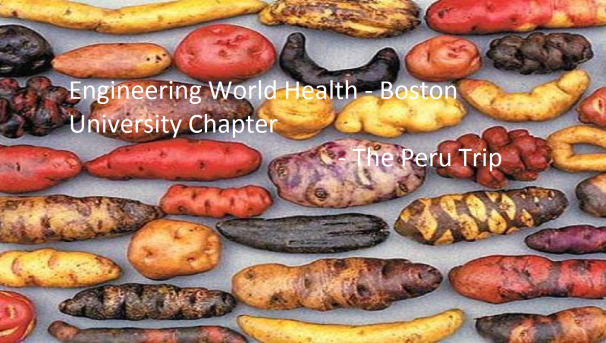




Engineering World Health Peru Trip
 Engineering World Health - Boston University Chapter is an organization on campus that aims to inspire, educate and empower biomedical engineers and connect them to developing countries.
In order to insure that we biomedical engineers have opportunities that help us refine our skills, it is important that we visit developing countries. It is vital that we come back with a more realistic understanding of how we can help native people achieve sustainable approaches to important health and development issues. We must not think of ourselves as visiting saviors, as much as, partners with the local people (fellow engineering students), jointly seeking realistic and practical solutions to vexing problems.
The Peruvian NIH director has stated that there are three important issues facing the health and quality of life of Peruvians today - Heavy Metal Toxicity, Maternal Health and Child Development, and Health Technology Assessment. The first two issues are directly relevant to the current health realities of Peruvians today and the last is an important enabling ability that will insure the emergence of a modern healthcare-delivery system in Peru. We believe these issues are not only pertinent to Peru, but to many other developing countries in Latin America and Africa and even to developed countries like the USA. Our faculty adviser, Professor Herbert Voigt, has been involved with Peru for a few years and has recently completed his sabbatical visit working with two Peruvian Universities (Pontificia Universidad Católica del Perú | PUCP and Universidad Peruana Cayetano Heredia | UPCH) (Professors Vilcahuaman, Rivas and Terrones) and helping to create a joint undergraduate program in biomedical engineering and working with the Peruvian NIH on these issues. He also co-organized, with the Peruvian NIH and Professor Rivas, a course on Heavy Metal Toxicity and Detection.
An ultimate goal of this visit is to establish stronger and long-lasting relationships with PUCP, UPCH and the Peruvian NIH that will promote student and faculty exchanges between Boston University and the Peruvian institutions. This first visit of EWH students will assess the possibility of longer visits to Peru during the summer to participate in more sustainable projects.
Hence we plan to visit Lima, Peru where we will be working in groups of 3 Boston University students with 1-3 Peruvian students on the following projects:
1- Heavy Metals: Peruvians have long participated in illicit gold mining using liquid mercury (Hg) to extract gold from their soil. This Hg gets into the waterways and poisons fish and the children and adults who eat that fish, with disastrous results. In addition, groups of people are known to have multiple heavy metal toxicities. In addition to Hg, people are contaminated with lead (Pb), arsenic (As) and/or cadmium (Cd). We will be looking to create increased awareness by the Peruvian students of the medical implications of Hg, Pb, As, and Cd poisoning in children, adults and animals. We will discuss various modern methods of determining heavy metal poisoning and produce a proposal to measure heavy metal contamination in various regions of Peru.
2 - Maternal Health and Child Development: We will partner with the Peruvian biomedical and clinical engineering students and will be focusing on the diagnosis of stomach infection, pneumonia respiratory and malnutrition. We will learn about the healthcare delivery system in Peru and suggest approaches that allow gathering of reliable statistics regarding infant and mother survival data. We will visit two maternity hospitals in Lima to assess their infant facilities.
3 - Health Technology Assessment (HTA): This component will be led by the head of public service of the Peruvian NIH. We will obtain the 2016 equipment repair work orders from a variety of Lima Hospitals to determine the type and frequency of various equipment failures by department. From this we will track the fate of the equipment - reason for failure, age of equipment, length of time in repair, etc. We will seek to determine the skills required to fix the instruments and determine who (what level of training was needed). After the week, we will propose a course of action that will seek to return broken hospital and clinic equipment to service more rapidly.
Our Main Aims to Accomplish:
We aim to establish a connection between the students of Boston University, PUCP and UPCH. As such, students will be divided into 3 groups associated with each project. Each group will have at least two students from the PUCP-UPCH biomedical engineering program, where they will be able to share their experiences and concerns regarding the health care program and education system.
We wish to determine if there are interests in establishing a long-term relationship between Boston University and these Peruvian institutions.
$25
Social Media Shoutout
We, Engineering World Health - Boston University Chapter, will tweet your support and post it on our Facebook Page for all to see!
$36
Group Photo
You will receive a photo of the EWH-Boston U Team working with our Peruvian Team mates.
$50
Thank-you Video
We, Engineering World Health - Boston University Chapter, will create a thank-you video that includes images from our Trip. We sincerely thank you for your support!
$100
Signed Card from Peru
We will send you a signed card directly from Lima, Peru!
$500
EWH - Boston U t-shirt
We will send you an official EWH Boston University Trip to Peru 2017 t-shirt
$1,000
A Peruvian Tumi
You will receive a small replica of a Peruvian Tumi. The Tumi is a ceremonial knife used by ancient Peruvian cultures as a means to perform sacrifices. It consists of two parts, a semi-circular blade and a handle often representing the northern Peruvian God Naymlap.